
Copiah County Parole and Probation
Parole and probation can both place a person in the community under rules, but they begin in different ways. The Mississippi State Parole Board decides whether to grant or deny parole. Parole is a conditional release connected to an MDOC prison sentence. Probation is imposed by a court, either instead of a prison term or as part of the court's sentence. MDOC Division of Community Corrections performs field supervision for parole, probation, earned-release supervision, and other community statuses. A person living in Copiah County may therefore report to the same local office under a very different legal basis.
The public label matters. Someone outside a secure prison can remain in MDOC's legal custody or under a court's control. A grant of parole also may precede the date the person actually leaves an institution. Conversely, an old release stays part of the history even if a later violation returns the person to jail. Treat institutional release, the start of community supervision, and the end of supervision as separate events.
| Point | Parole | Probation |
|---|---|---|
| Who authorizes it | Mississippi State Parole Board | Sentencing court |
| What it follows | Conditional release from an MDOC sentence | A court sentence that may or may not follow prison |
| Local supervision | MDOC Community Corrections | MDOC Community Corrections |
| Best source for the basis | Board action and MDOC record | Court order and MDOC record |
| How it may end | Expiration, discharge, or Board action | Court discharge or expiration shown in the record |
- Parole
- Conditional release from an MDOC sentence under rules set by law and the Parole Board.
- Probation
- Court-ordered supervision in the community.
- Discharge
- The recorded end of a sentence or supervision term, not merely absence from a search result.
- Absconder
- A public status alleging loss of contact or noncompliance. It is not itself a new conviction.
Verify Copiah County Supervision
Start with the custody system that produced the sentence. The MDOC offender search is the statewide route for a person who entered state custody or state community supervision. It is not a record of every Copiah County Jail booking. Search with the MDOC number when known because it is more precise than a name. When only a name is available, use the legal first and last names and compare a candidate's county of conviction, offense, sentence, and public status before treating the record as a match.
Read the displayed term exactly. A probation or parole office shown as the location can mean the person has left secure custody but is still supervised. A tentative date does not prove an actual release. If no MDOC result appears, the matter may have stayed in Copiah County court, ended without a state sentence, use a different spelling, or be withheld from the public display. The county court order and the original jail release entry remain useful in those cases. The broader Copiah County released-inmate search path explains how the sheriff docket and court record fit together.
Use this sequence to verify a named case:
- Search the MDOC record by number, or by exact name when the number is unknown. Save the displayed MDOC number and status.
- Match at least two non-sensitive facts, such as county of conviction, middle initial, age, offense, or case number.
- Call the listed or likely Community Corrections office. Ask whether supervision is active, completed, transferred, or revoked and which office holds the case.
- For probation, obtain the sentencing or discharge order from the proper court. For parole, ask the Parole Board for the named action record.
- If a later warrant or return to custody appears, record it as a new event rather than erasing the prior release.
Some details will remain private. Home addresses, treatment information, victim information, investigative material, and protected case notes are not part of a routine public-status check. Ask for the narrow facts needed to confirm status and office assignment.
Copiah County Supervision Office
Copiah County has a named Community Corrections office in Hazlehurst. This is the distinctive local route for an active state-supervision case. It is not a jail, a place where an inmate is released, or a public release list. The office can help identify a reporting office or navigate an active parole, probation, or other MDOC community case. Residence, a transfer of supervision, or a specialized caseload may cause a person convicted in Copiah County to report elsewhere, so county of conviction alone does not settle the assignment.
The official MDOC office page supplies the local address, director, phone, and fax:
Copiah Probation & Parole Office215 South Extension Street
Hazlehurst, MS 39083
Mailing: P.O. Box 641
Phone: 601-894-3806
Fax: 601-894-5729
Community Corrections Director: Jason Carney
No official office hours were located in the project research. Call before traveling. Give the full name and MDOC number, then ask for public status and the office responsible for the case. Do not ask the office to treat a community status as proof of an unconditional discharge.
The official Copiah Probation & Parole Office view below confirms that this supervision contact is an MDOC facility listing. It does not function as an offender roster.
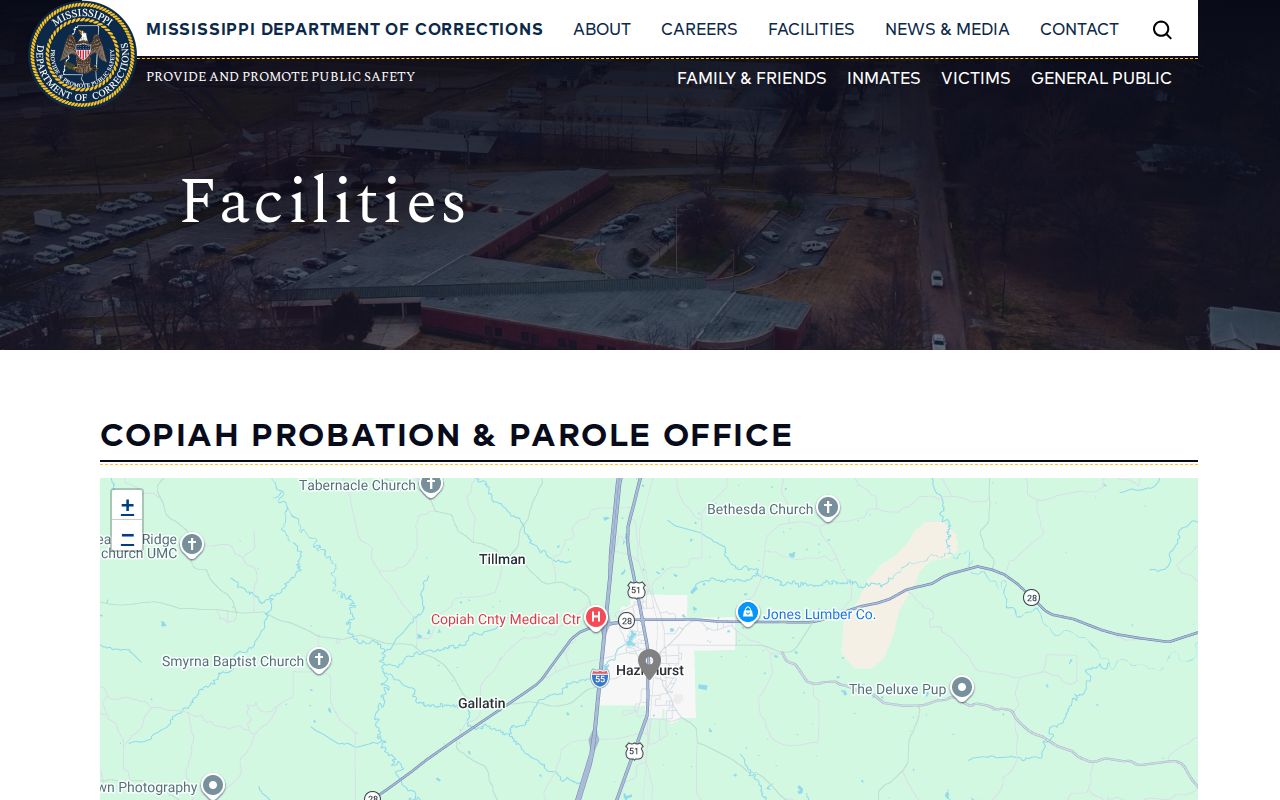
The screenshot identifies the local Community Corrections channel, while a person's status still must be checked in the proper MDOC or court record.
Copiah County Parole Decisions
Mississippi divides parole work among two agencies. MDOC calculates dates, creates the eligible-offender list, and supervises people after a grant. The Parole Board alone grants or denies parole. MDOC states that an eligible list is generated each month and sent to the Board, but that cadence is not a public hearing calendar for each named person. No current official public hearing calendar or searchable decision portal was verified in the research.
For a named Copiah County case, contact the Board with the full name and MDOC number. Ask for the hearing date, the action or decision record, any public reason, and next-review information if one exists. The official state directory lists the Mississippi State Parole Board at 239 North Lamar Street, Suite 501, Jackson, MS 39201, with telephone 601-576-3520. A narrow written public-record request may be used if the requested decision record is not supplied through the first contact.
Eligibility, a Board decision, and release are distinct stages. Mississippi Code section 47-7-3 sets the main eligibility framework, including offense-date categories and exclusions. It does not establish one universal fraction for every sentence. Even after a grant, institutional processing and an approved plan can stand between the decision and actual departure. Confirm community supervision through MDOC after release.
Note: A monthly eligibility list does not establish a hearing date, a favorable Board action, or the date a person left custody.
Copiah County Violations and Warrants
Community supervision carries conditions set by the court, Board, law, and MDOC. Public records may show reporting duties, approved residence rules, or other broad conditions, but protected treatment and case details should not be inferred. An alleged violation can lead to a warrant, arrest, and a revocation process. Revocation means a court or the Board acts to withdraw community supervision after the required process. It should not be assumed from rumor or from a stale search screen.
An absconder status generally means the agency alleges that contact was lost or the person failed to comply. It is not a new conviction. Nor does it prove the person's current physical location. Verify whether a warrant exists through the agency that issued or holds it, then check the latest custody source. Mississippi SAVIN/VINE can send notices about return from absconder supervision, absconding, transfer, or release when the participating agency transmits the event. Each event label must be read on its own terms.
A clean timeline prevents a common error. Record the original prison or jail release, the start of supervision, the alleged violation, the warrant, any new custody, the revocation decision, and eventual discharge as separate entries. A later arrest does not make the earlier release date false. It adds a later custodial episode that needs its own source.
Copiah County Supervision Notifications
The Office of Mississippi SAVIN uses VINE for custody-event alerts. Notifications can concern release, transfer, rehousing, temporary movement, escape, absconding, or return from absconder status. This range is useful for following changes, but it is also why one automated message cannot be read as a final discharge record. County-jail coverage applies only when the county is participating and sending the relevant data. MDOC offenders are part of the statewide corrections channel.
Search the exact person and compare the agency, facility, identifier, and age or other safe match facts. After choosing the correct record, register through the offered phone, text, or email option. Phone notices use a PIN acknowledgement. Save the confirmation, note the event time and source agency, and confirm the event through the agency record. Direct victims of an MDOC offender should use MDOC Division of Victim Services rather than relying only on anonymous registration.
The Office of Mississippi SAVIN can be reached at 601-359-5759, at 1-888-967-7284 around the clock, or by TTY at 866-847-1298. Those lines can help confirm what an alert meant. They do not replace the Parole Board record, court order, or MDOC discharge evidence.
Note: A VINE transfer alert can mark movement into another custody system, not release into the Copiah County community.
When Copiah County Supervision Ends
Final discharge depends on the legal basis. A court may discharge probation. MDOC may record expiration or discharge of a community sentence. The Parole Board may act within its authority on parole. The most reliable closing proof is the actual court, MDOC, or Board record, not the disappearance of a person from an online screen. Ask the custodian to identify the effective date and exact status label.
Keep conditional liberty distinct from sentence completion. “Parole,” “probation,” “earned-release supervision,” “inactive,” “expired,” and “discharged” should not be treated as synonyms. If the label is unclear, give the office the MDOC number and ask what public record defines the endpoint. When a revocation or transfer occurred, request enough of the dated record to distinguish the end of one supervision phase from the start of another.
Copiah County records can then be reconciled in sequence. The jail docket shows how the sheriff released or transferred the person. The court order explains a probation term or later discharge. MDOC documents state custody and community status, while the Board record supports a parole action. Together, those records show whether the person remains supervised and when that supervision lawfully ended.