
Copiah Released Mugshots and Records
A booking photograph records appearance during a particular arrest and booking. It is not a live custody marker. The image can remain in an agency file after the person leaves Copiah County Jail, while a current roster may omit the whole episode. A later photo can also differ from an older one. Always connect the image to the exact booking date or booking number rather than treating it as a permanent portrait.
Mississippi's Public Records Act supplies a general way to request an agency-held record, but the research did not find a statute declaring every booking photograph public in all circumstances. Juvenile confidentiality, a sealed or expunged matter, an investigation-related exemption, victim protections, or another law may limit access. A custodian should cite the legal basis for withholding and release any reasonably separable public part.
Photo and release records answer different questions. The photo may establish which image an agency associated with a booking. The sheriff's jail docket establishes the duration and manner of release or discharge. A person can be photographed, released on bond, transferred to another agency, acquitted later, or remain under supervision. The image alone proves none of those later facts.
Where Copiah Booking Photos Appear
No single photo source covers every released person. Copiah's official public channels are especially limited because the sheriff does not publish a verified roster, released-person gallery, or mobile app. Choose a channel based on the actual custody history and record type.
| Channel | Photo availability | How to access and interpret it |
|---|---|---|
| Copiah sheriff website | No inmate gallery verified | Use the official contact page to reach the sheriff, not as a photo feed |
| Copiah sheriff records request | Primary local route | Request the image for one exact booking episode in its existing electronic format |
| MDOC offender search | May show a state image | Only for a person with an MDOC history; it may not be the Copiah booking photo |
| Mississippi registry | May show a current registry photo | Only for persons legally required to register; not a general release search |
| News report | Sometimes | An agency-supplied image supports only what that dated report says |
| Commercial directory | Sometimes, often stale | Not an official release authority; no commercial mugshot source is endorsed or linked |
VINE can report custody events for participating agencies, but it should not be treated as a permanent booking-photo archive. A source that displays a face but cannot identify the agency, booking episode, or capture date is weak evidence. Confirm identity with more than a name and avoid republishing private or restricted details.
No Copiah Mugshot Feed or App
The official Copiah County Sheriff's Office page provides jail and agency contacts, but no current inmate roster, recent-release cards, inmate-photo gallery, or official social release feed was verified there. The county forms page also has no dedicated sheriff records or booking-photo request form. No reliable official Copiah sheriff mobile app was found in the exact-name sweep.
This negative finding matters. An app run for another Mississippi county cannot be substituted. A vendor directory that puts “Copiah County” in its title does not become an official sheriff channel. It cannot establish when the photo was posted, how often it is refreshed, whether the person was released, or how long the image stays online.
The official sheriff capture shows the agency page that supplies Copiah County Jail contact information.
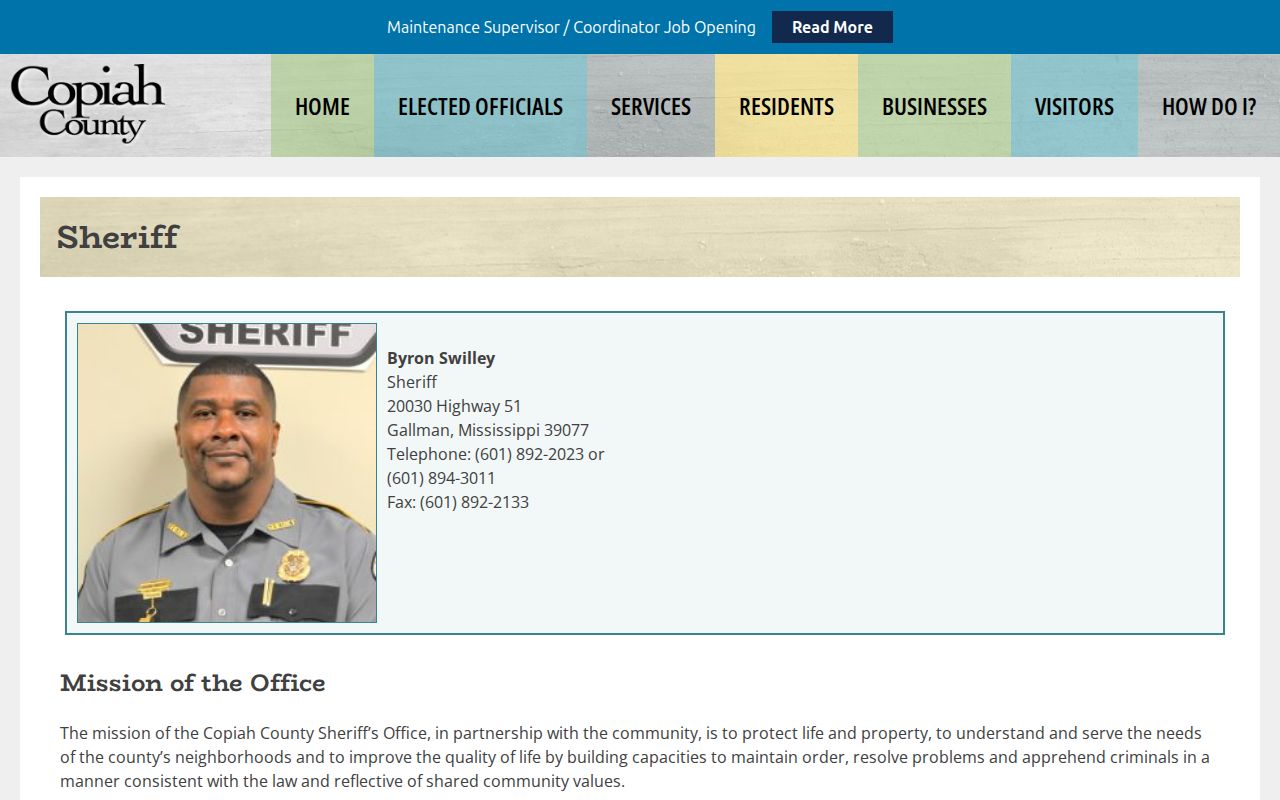
The page is the correct contact starting point, but its staff photographs are not inmate images and must never be presented as booking records.
The absence of an online gallery does not prove that the sheriff lacks an agency-held image. It means a precise records request is the supported local route. Readers looking for the same-day release context can separately check the Copiah County 24-Hour Releases process, which also relies on the sheriff's existing records rather than an invented feed.
Note: Copiah County publishes no verified photo-display window, update schedule, or web retention period for a released person's booking image.
Request a Copiah Booking Photo
A narrow written request reduces mistaken identity and limits the search to the correct booking. The Copiah County Sheriff's Office is at 20030 Highway 51, Gallman, MS 39077. Its official numbers are 601-892-2023 and 601-894-3011, with fax 601-892-2133. No public email, fixed copy fee, or county-specific photo form was verified. Call first to confirm where written requests should be delivered.
- Identify the person by full legal name and any known alias. Add the approximate booking date, booking number, or case number.
- Ask for the original booking photograph tied to that episode as a separate electronic file in its existing format.
- Request the associated jail-docket release or discharge entry. This keeps the image from being mistaken for proof of present custody.
- Ask the office to release nonexempt portions and cite each statutory basis for any withholding or redaction.
- Request an itemized estimate before chargeable work begins, and state a maximum amount that requires further approval.
- Keep the response, source agency, booking identifier, and access date together with the image.
Under Mississippi Code § 25-61-5, an agency follows its reasonable written procedures. When none apply, the statute provides a one-working-day access rule, while procedures cannot set production or denial later than seven working days. If production cannot occur by then, the agency must give a particular written reason and a production commitment, generally no later than fourteen working days absent agreement.
Section 25-61-7 limits charges to reasonable actual costs and allows advance collection. A requester should not assume the image is free. If the agency denies access, ask for the denial in writing, the precise exemption, and release of any separable portion. A focused photo request is not a demand for the full investigative file.
State Photos After Copiah Release
The MDOC offender search may contain a photograph for someone who entered state corrections. That is an MDOC image. It is not necessarily the photograph taken during a Copiah County Jail booking. Nor does the image prove the exact county departure date. Label it as a state corrections image and record when it was viewed.
A person whose local case was dismissed, remained a misdemeanor, or never produced an MDOC sentence may have no state corrections result. A zero result therefore says nothing conclusive about whether a Copiah booking photo exists. Search the correct agency record first.
The Mississippi Sex Offender Registry is narrower still. It may display a current public photo for a person legally required to register. It does not cover released people as a group. State guidance warns that the information can change and that fingerprints, rather than a visual match alone, conclusively establish identity.
The official registry landing page illustrates this limited, purpose-specific source.
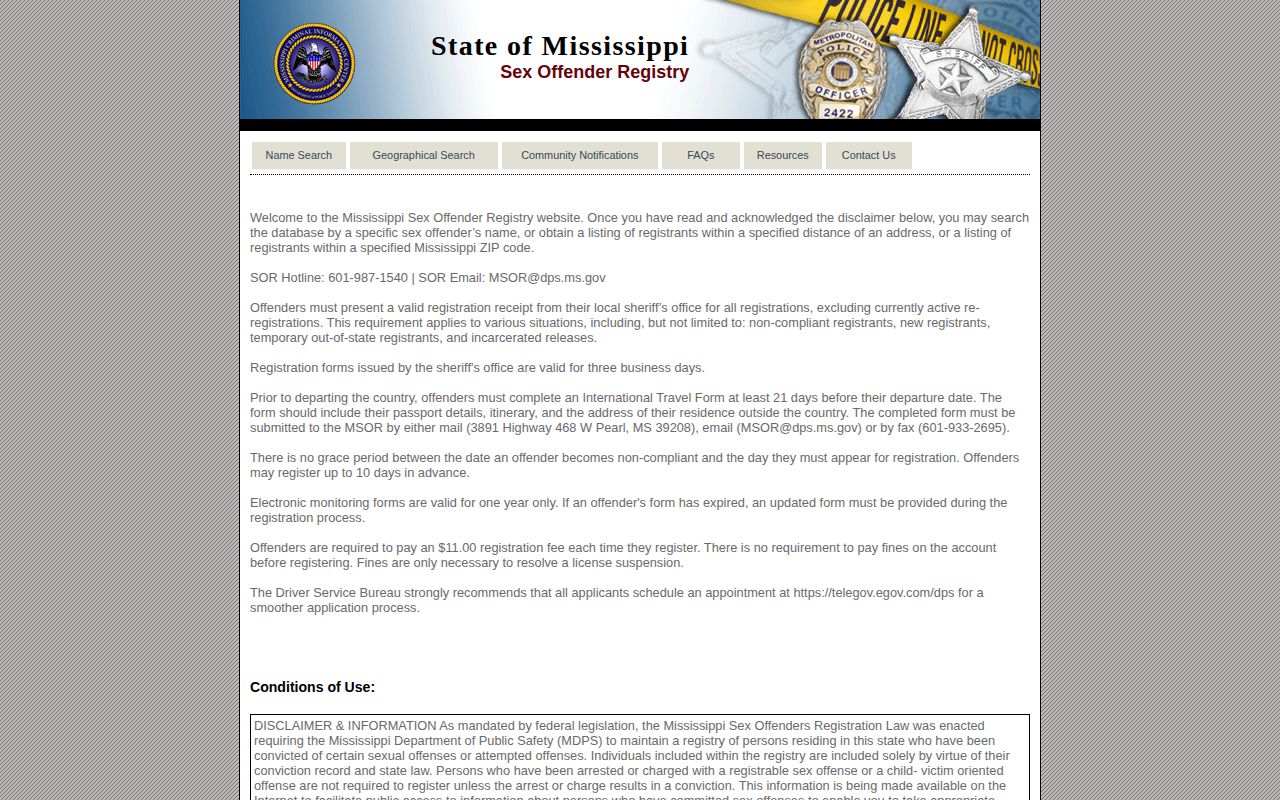
A registry image must be called a registry photo, not a Copiah mugshot. The registry should never be used as a substitute for a general release list.
Outside Copiah Mugshot Copies
News outlets sometimes publish an image supplied by an agency when reporting an arrest or jail event. The article may preserve the picture after the official source changes, but it proves only what the dated report says. It may predate dismissal, acquittal, sentence completion, or release. Compare the story's date and attribution with the sheriff and court records.
Commercial mugshot and jail-directory pages can be stale, misidentified, or detached from case outcomes. They are not release authorities. No commercial mugshot publisher, data seller, or paid-removal service is linked or endorsed. If such a page is encountered independently, treat it as a lead to verify, not as proof of identity, custody, release, or current legal status.
An independent copy may also remain after the source agency changes access. A court order should be sent to each lawful custodian or publisher whose record is at issue. Do not assume that an order served on the sheriff automatically reaches every outside archive.
Note: A photo's continued appearance does not mean the person is still held, and its disappearance does not establish release or expungement.
Copiah Mugshots After Expungement
Release is not expungement. Mississippi Code § 99-19-71 provides a court process for eligible matters. Subsection (4) is especially relevant when a person was arrested and released, then the case was dismissed, charges were dropped, no disposition occurred, or the person was acquitted. The person must still obtain an order from the proper court. The release event alone does not erase the jail docket, court index, or copied photo.
Current law also reflects HB 1546, effective July 1, 2026. For one qualifying felony within the statute, the general waiting period is three years after successful completion of all sentence terms and conditions, with fines and court costs paid. Numerous categories remain excluded. The text and the actual court record control eligibility.
After an order is entered, send it to the sheriff, the proper court clerk, and any other lawful custodian that displays the record. Ask what steps are needed for implementation or correction. The scope of an order may differ across records. Juvenile and already sealed material should not be republished in the first place.
Verify Copiah Photo and Release
Keep the photo inquiry separate from the release inquiry, then join them through the booking identifier. The sheriff's photograph can support which image belonged to a booking. The permanent jail docket required by § 19-25-63 can show duration and how the person was released, discharged, or sent to another custodian. The court file can explain the order or disposition behind that event.
For an MDOC history, compare the state photograph and offender number with the county record, but preserve the different source labels. For a registry result, note that its image is limited to a statutory registration system. For news or other copies, preserve the publication date and agency attribution. Do not combine images from separate booking episodes merely because the names match.
Identity should rest on at least two non-sensitive identifiers, such as a middle name, age or birth year, booking or case number, MDOC number, or county of conviction. Avoid sharing a full birth date, home address, victim information, juvenile information, or sealed material. The full Copiah County release-record process supplies the official sequence for checking whether the matching person left the county jail, transferred, or entered another custody system.