
Copiah County 72-Hour Releases
The Copiah County Sheriff's Office provides official jail contacts, but it did not publish a current roster, released-person view, or 72-hour filter when public channels were checked on July 26, 2026. The county's page sitemap, post sitemap, and forms page also yielded no official rolling release tool. No feed means there is no supported claim about an online refresh cycle, three-day retention setting, release-card photo, or archived view.
A three-day list must be assembled from records the sheriff already keeps. Ask for existing jail-docket entries whose actual release or discharge time falls within exact endpoints. If the jail cannot produce a time-filtered export, request the relevant docket pages and three daily prisoner or meal logs. The response format matters. A database extract may reflect selected fields, a daily log may serve a custody or meal-accounting task, and the statutory docket is meant to retain the case history.
The captured official Copiah County sheriff page identifies the local contact source, but it displays no three-day release tool.
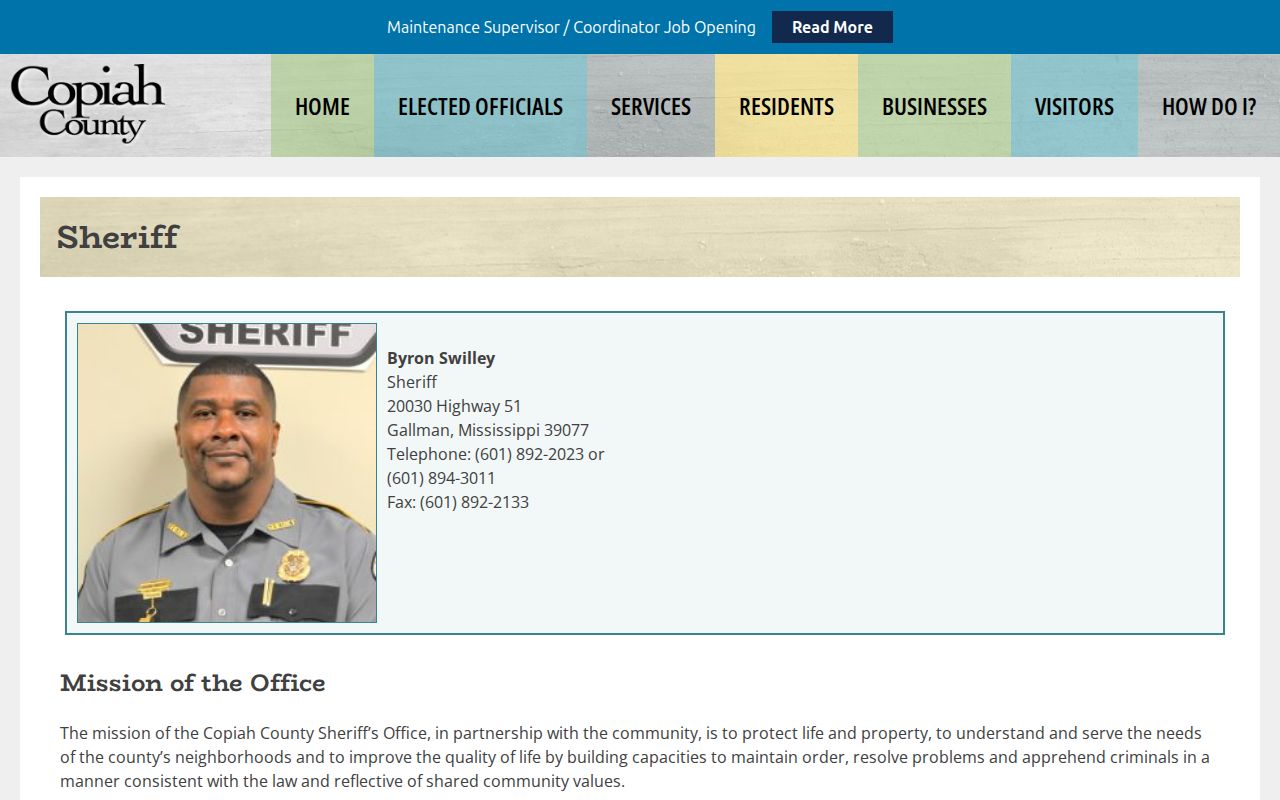
The screenshot supports the records-first route and does not imply that a roster or release-card archive exists.
No official feed: Do not treat a commercial Copiah-branded roster as proof of release, transfer, update timing, or county record retention.
The lack of instant browsing is inconvenient, but it does not remove the record. Copiah's durable jail docket can establish the event after a rolling web window would have expired.
Define Copiah's 72-Hour Window
“Last 72 hours” and “last three calendar days” are different requests. A rolling 72-hour period begins at a precise time and ends at the same time three days later. Three calendar days begin and end at midnight. Around a weekend, those two methods may include different Friday or Monday records. State which method is wanted and use Central Time for both endpoints.
Exact timestamps also make the result reproducible. Someone reviewing the request later can apply the same boundary. If a known person does not appear, search a short adjacent span because a court order, administrative entry, and actual departure can fall on separate dates. Expanding the boundary is more sound than changing a release time to fit the expected result.
- Choose a rolling 72 hours or three named calendar days, then record both endpoints in Central Time.
- Contact the Sheriff's Office and ask for existing jail-docket entries with a recorded release or discharge time in that span.
- Request the name, booking or commitment date, actual exit date and time, release method, legal authority, and receiving agency.
- If no filtered export exists, ask for the relevant docket entries and the daily prisoner or meal logs for all included dates.
- Ask for records in their existing electronic form, an itemized cost estimate, and the statutory basis for any withheld part.
- Check adjacent dates when the order, data entry, and actual departure may have crossed midnight.
The Sheriff's Office lists 20030 Highway 51, Gallman, MS 39077, phone 601-892-2023 or 601-894-3011, and fax 601-892-2133. Call to confirm where written requests should be sent. No official request email, sheriff records form, office hours, or fixed local copy fee was found. The county forms page contains no booking or release form.
Note: A date range should identify existing records and should not demand that the sheriff create a new public report.
Copiah 72-Hour Release Fields
Since Copiah County has no public release card, the useful fields come from the jail docket and supporting logs. Ask for each field in the office's original terms. A transfer entry should remain a transfer. Turning all exits into “released” would hide whether custody continued with MDOC, another county, a federal agency, or immigration authorities.
| Field | How to read it in a three-day list |
|---|---|
| Name and booking reference | Separates the right person and episode from similar names or a prior stay. |
| Commitment or booking date | Shows when custody began and may fall well before the three-day range. |
| Actual release date and time | Determines whether the exit is inside the exact requested endpoints. |
| Release or discharge method | Preserves bond, court order, time served, completion, transfer, or the record's other label. |
| Legal authority | Identifies the warrant, order, or action supporting the jail's custody change. |
| Receiving agency or receipt | Shows that the person remained in custody when another agency accepted the transfer. |
The order date is not a substitute for the actual release date. Nor is a projected date. A judge may authorize release before jail staff complete the required process, while a receiving agency may take custody after the county episode ends. The field table is most useful when the actual exit and legal basis are read together.
Copiah Weekend Release Timing
A wider request is useful when a one-day check would miss a release near Friday, Monday, or a holiday. It does not justify assumptions about Copiah County's schedule. No official weekend-release rule, holiday practice, or fixed bond-processing hour was published in the sources reviewed. Courts and records offices can have business schedules while a jail responds to legal authority on a different operational timetable.
Call the jail for a recent status. Then ask for a dated record. If a court order was entered late in the day, the physical departure may occur on the next date. The reverse problem can also occur when a log or database entry is posted after the recorded event. Searching an adjacent day can resolve that boundary without inventing a “Friday release” custom.
A three-day span is also better for comparing court and jail records. The Copiah Justice Court handles misdemeanors, initial appearances, bond setting, and preliminary felony matters. The Circuit Clerk keeps felony proceedings, orders, and minute references. A court record explains why release was authorized, while the sheriff's record proves how and when Copiah custody changed.
Weekend check: Use exact timestamps and inspect the next date when a late order, release process, or record entry crosses midnight.
Copiah Release Docket Retention
Copiah's lack of an online 72-hour view makes the permanent record route especially important. Miss. Code § 19-25-63 requires the sheriff's jail docket to include how long each prisoner was held and how the person was released or discharged. The statute calls the docket a public record and says it passes to the sheriff's successor. Access therefore does not depend on a release card staying online for three days.
The Copiah County FY2018 audit provides local support for the time fields. It described prisoner records that listed the date and time of incarceration and release and said those records were posted daily under state law. The audit is not evidence of a present public feed or a guaranteed current log format. It is a sound basis for asking whether the daily logs can supplement the docket.
Other items may not share the docket's retention rule. Photos, meal logs, extracts, and working copies can fall under separate state and local schedules. Identify the exact item, booking episode, and date. If the office withholds part of a record, ask it to produce any separable public portion and identify the specific legal basis for the rest.
Mississippi's Public Records Act permits actual-cost fees. Where no reasonable written procedure exists, access is due within one working day. Procedures may allow up to seven working days, with a specific written explanation and later production commitment when production cannot occur by then. These deadlines govern the records process, not how fast a jail release takes place.
Note: The jail docket survives sheriff transitions, while supporting logs and images may have their own retention and access limits.
Verify Copiah Release or Transfer
A three-day entry answers when Copiah County custody ended or changed. It does not always answer where the person is now. A bond, recognizance, dismissal, time-served disposition, court order, or completed local sentence may support release to the community. A handoff to the Mississippi Department of Corrections, another jail, the U.S. Marshals Service, or ICE is a transfer and means custody continued.
| County community exit | Confirm the actual time and method in the sheriff's docket, then use the court order for the legal basis. |
|---|---|
| MDOC transfer | Search by MDOC number or name, then compare county of conviction, sentence, status, and location. |
| VINE event | Read the event and participating agency. A transfer alert is not proof of return to the community. |
| Federal or ICE handoff | Use the receiving system only when the Copiah entry or other facts point to that custodian. |
| Still held in Copiah | A current jail answer describes present custody and should not be placed on a release list. |
The MDOC offender search applies to a state sentence or community-corrections history, not every Copiah booking. A local misdemeanor, dismissal, or county-only case may never produce an MDOC number. Mississippi VINELink may supply a custody event for a participating agency, but a missing result does not prove release and an alert does not replace the docket.
When only the same calendar day is needed, narrow the request with the Copiah County 24-Hour Releases instructions. For one known person whose trail may cross county, state, court, or federal systems, use the Copiah County released-inmate lookup. The 72-hour request is designed for a defined group of exits, especially when the span crosses nonbusiness days.
Names can repeat. Match at least two non-sensitive details, such as a middle name, age or birth year, booking or MDOC number, cause number, offense, or county of conviction. Do not republish sealed, juvenile, victim, or other restricted information that may appear in a source.
Note: Release from the Copiah County Jail and release from all government custody are separate facts that require separate proof.