
Copiah County 24-Hour Releases
The Copiah County Sheriff's Office did not link an official current roster, released-inmates view, or rolling one-day feed when the public channels were reviewed on July 26, 2026. The county page lists the jail and its staff, but it provides no filter that can answer who left today. The absence of a public screen does not mean the office lacks an internal booking system. It means there is no verified web list whose fields, refresh rate, or time window can be described as official.
The practical substitute is a narrow request for existing records. Ask the jail whether it can inspect or export entries with an actual release or discharge time inside the chosen day. If it cannot run that query, request the relevant jail-docket entries and the daily prisoner or meal log for the same span. A response may be a docket extract, copies of log pages, or another record already kept by the office. Mississippi public-records law does not require an agency to create a new report that it does not maintain.
The captured official Copiah County sheriff page shows the contact route available in place of a 24-hour release feed.
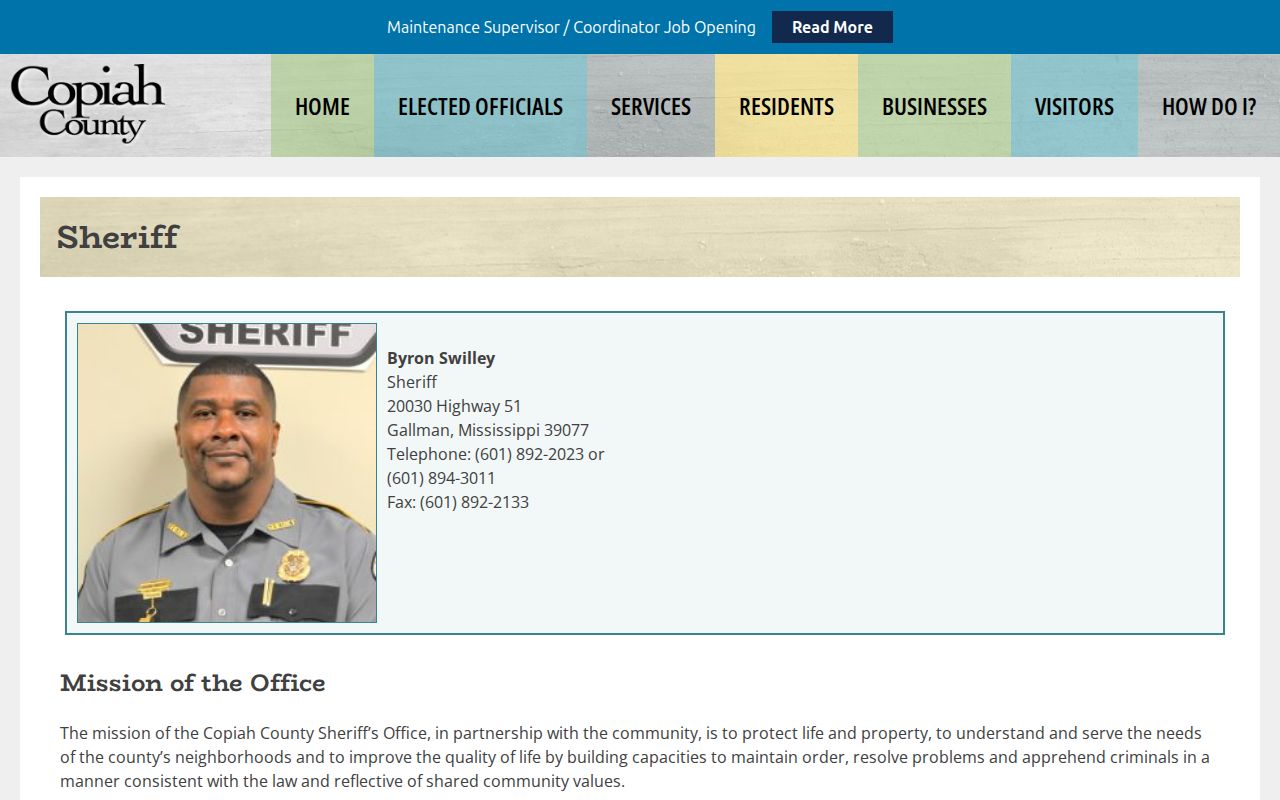
The image documents the county source to contact, while the jail docket remains the record that proves a same-day release or transfer.
Verify the event: A recent phone answer or data entry can change. Obtain the dated docket entry when the exact release time or destination matters.
For a broader period that may catch a late entry, compare the Copiah County 72-Hour Releases. The one-day request remains the better choice when a precise calendar date is already known.
Request Copiah 24-Hour Release Entries
Define the one-day period before contacting the sheriff. A request for “today's releases” can become unclear after midnight or when the reader and jail are in different time zones. Give both endpoints in Central Time. For a calendar-day list, one clear formulation is “12:00 a.m. through 11:59 p.m. Central on [date].” For a rolling period, name the exact date and time at both ends. Ask only for records that already exist in that span.
The Sheriff's Office lists 20030 Highway 51, Gallman, MS 39077, with telephone numbers 601-892-2023 and 601-894-3011 and fax 601-892-2133. Call first to ask how a written records request should be sent. No Copiah-specific request email, downloadable sheriff form, fixed copy fee, or records-office schedule was verified on the official site. The county forms page also does not provide a jail-release request form.
- Write the exact start and end timestamps in Central Time, and state whether the request is for one calendar day or a rolling 24 hours.
- Ask for existing jail-docket entries whose recorded release or discharge time falls in that interval.
- Request name, booking or commitment date, actual release time, release method, legal authority, and receiving agency when a transfer occurred.
- If no time-based extract exists, ask to inspect the daily prisoner or meal log and matching docket entries for that date.
- Seek the existing electronic format, ask for an itemized cost estimate, and authorize no chargeable work above a stated limit without notice.
- Record when the answer was received, then compare any disputed entry with the court order or receiving agency record.
Under the Mississippi Public Records Act, an agency follows its reasonable written procedures. When it has none, access is due within one working day. Procedures may not set production or denial later than seven working days. If production cannot occur by then, the agency must give a specific written explanation and production commitment, generally no later than fourteen working days absent an agreement. Fees must reflect actual costs under Miss. Code § 25-61-7.
Note: Ask for existing entries, not a newly compiled public feed, because record access does not compel creation of a custom list.
Copiah 24-Hour Release Fields
No official online release card exists, so the table below describes the fields to request from Copiah County records. The sheriff's statutory jail docket supplies the legal history. The daily log can add the actual date and time recorded for the custody episode. Ask the office to preserve its own wording rather than turning every result into “released.”
| Field | What it establishes |
|---|---|
| Name and booking reference | Connects the entry to the right person and custody episode. |
| Received or commitment date | Marks when the jail episode began, not when it ended. |
| Actual release date and time | Places the recorded exit inside or outside the requested 24-hour period. |
| Manner of release or discharge | Distinguishes bond, court order, time served, sentence completion, and other outcomes. |
| Release authority | Points to the warrant, court action, or other legal basis for the jail's action. |
| Receiving agency or receipt | Shows when the person went to MDOC or another custodian instead of the community. |
Three dates can differ. The booking date starts custody. A judge's order may be entered before jail processing is complete. The actual release time records when custody ended or changed. If only the order time appears, request the jail log before placing the event in a one-day list.
Copiah Bond Release Timing
Copiah's court structure helps explain one common same-day release without proving its hour. The Copiah Justice Court says a justice judge sets bond at a felony initial appearance. It also describes preliminary-hearing rights for defendants who have not bonded out. That court action establishes the legal path that may permit release, but the signed or satisfied bond event is not the same as physical departure from the jail.
Pair the court record with the sheriff's release entry. The court file may show the bond amount, order, or later disposition. The jail docket shows how long the person remained and how the sheriff discharged the person. A release that crosses midnight can therefore belong to the next day's list even if the judge acted before midnight. Do not shift the event back to the order date for convenience.
Bond is not case closure: Release on bond ends that period of detention, but the charge and court process may continue.
Copiah Release Docket Advantage
Copiah County has a request-first process rather than a temporary online card. That is slower than opening a feed, yet the underlying record is stronger. Miss. Code § 19-25-63 requires the sheriff to keep a complete jail docket that includes how long a prisoner was held and how the person was released or discharged. It also makes the docket public and requires its transfer to each successor sheriff.
Local evidence adds useful time detail. The Copiah County FY2018 audit described prisoner records listing each prisoner's date and time of incarceration and release and said those records were to be posted daily under state law. That audit does not prove that the same log is now online or kept in the same format. It does support asking for the daily log when an exact same-day timestamp is needed.
Related material may follow different retention rules. Booking photos, working exports, meal logs, and administrative copies are not automatically governed by the docket's successor-transfer rule. Request the permanent docket first, then identify any related item by the booking episode and date. This keeps an old or missing web page from controlling whether the release can still be documented.
Note: The statutory jail docket is the durable release source even though Copiah County publishes no rolling online window.
Copiah Release Apps and Photos
The official sheriff page links no released-person gallery, social release feed, or mobile app. An exact-name sweep also found no reliable official Copiah County Sheriff app with a release or mugshot function. A county-branded directory or general jail app should not be treated as the sheriff's source merely because it appears in search results. It cannot establish the county's release time, update cycle, destination, or photo policy.
If a booking image is needed with the one-day entries, request it separately. Give the exact name, booking date, and booking or case number when known. Ask for the original electronic image in its existing format, not a screenshot from a commercial page. The sheriff can then address format, cost, redaction, or any legal basis for withholding the image without confusing it with the public jail docket.
A photo proves identity only to the extent the source and booking are correct. It does not prove current custody, actual release, or community return. The dated release record must carry those facts.
Verify Copiah Release Status
A Copiah County jail entry can document several kinds of exit. Bond, recognizance, dismissal, time served, a court order, or completion of a local sentence may lead to the community. Transfer to the Mississippi Department of Corrections, another jail, the U.S. Marshals Service, or immigration authorities means custody continued elsewhere. “Gone from jail” covers both sets of events and should never be used as a synonym for freedom.
- Community release
- The county custody episode ends without another agency immediately accepting the person.
- Transfer
- Copiah County custody ends because another government custodian receives the person.
- Discharge
- The record's stated end of a custody or sentence status, which must be read with its source and legal basis.
- Projected date
- A future estimate or legal calculation, not proof that release occurred.
For an MDOC transfer, use the MDOC offender search and match the MDOC number, conviction county, sentence, and status. A person whose matter stayed local may never appear there. Mississippi VINELink can show a custody event for participating agencies and can support advance notification, but participation and data transmission must be confirmed for the named Copiah record. A VINE transfer alert is not community release.
When the court authorized release, obtain the matching Justice, County, or Circuit Court entry. When another agency accepted custody, follow that agency's record. For a named-person search across those systems, use the Copiah County released-inmate search path. The one-day jail request remains the source for proving who left Copiah custody in the chosen 24 hours.
Note: A person may be released from Copiah County while remaining in MDOC, federal, immigration, or another county's custody.