
Understanding Copiah County Releases
Leaving the Copiah County Jail does not always mean walking back into the community. A person may leave after posting bond, receiving a court order, serving the required time, completing a local sentence, or obtaining another lawful discharge. The same person may instead be transferred to the Mississippi Department of Corrections, another county, the U.S. Marshals Service, or immigration custody. All of those events end one county jail episode. Only some are community releases.
The most useful local record is the sheriff's jail docket. Mississippi Code section 19-25-63 requires a complete case history that includes how long the prisoner was held and how the person was released or discharged. When a person was sent to prison, the docket also records the penitentiary officer's receipt. That wording matters. It prevents a transfer from being flattened into the vague claim that someone was freed.
- Release
- The end of a custody episode under stated legal authority.
- Discharge
- An official end to custody or a sentence status, as the source uses the term.
- Time served
- A sentence or disposition satisfied by time already spent in custody.
- Detainer
- A basis for another agency to take or continue custody.
Copiah County Release Types
The exit label determines the next official source. A bond order may authorize departure while the criminal case continues. A dismissal or acquittal describes a court outcome, but the jail docket is still needed for the actual custody end. Parole and earned-release supervision allow some state prisoners to live outside a secure institution while remaining subject to MDOC rules. A transfer means custody continues elsewhere.
- Bond or court order
- County custody may end while the case stays open. Check the jail docket and court order.
- Time served or completion
- The local custodial term was satisfied. Compare the docket with the sentencing judgment.
- Parole or ERS
- State prison changes to conditional supervision. Use MDOC and Community Corrections.
- Agency transfer
- Copiah custody ends but confinement continues. Follow the receipt and receiving locator.
- Dismissal or acquittal
- The charge ends through court action. Pair the disposition with the release entry.
Three dates must remain separate. Booking or commitment begins the jail episode. A projected, tentative, parole-eligibility, or discharge date looks forward and may change. The actual release date and time documents what happened after processing was complete. A court's order-entry time may differ from the moment the person left the jail.
Note: Use the source's exact release label because a transfer and a community discharge lead to different records and next steps.
Copiah County Release Record Fields
A focused Copiah County release record request should identify one person and one booking episode. The statutory jail docket is broader than a roster card. It connects the reason for custody with the authority that ended or changed it, and it remains useful after any temporary display would have vanished.
| Field | What it shows |
|---|---|
| Name and episode | The person and specific county stay |
| Warrant or mittimus | The written authority for receiving the person |
| Issuing authority | The court or official tied to custody |
| Received and commitment dates | When the jail episode began |
| Cause or offense | The recorded basis for commitment |
| Duration | How long the person was imprisoned |
| Release or discharge method | Bond, order, completion, transfer, or another stated event |
| Release warrant or receipt | The legal document or proof another officer accepted custody |
A Copiah County audit also described prisoner meal logs that recorded the date and time of incarceration and release. That supports asking for the actual time when the docket extract does not state it clearly. The log serves an operational purpose, so it should not replace the permanent docket or court order.
Request Copiah County Release Records
No county-specific request form, posted sheriff email, or fixed copying schedule was verified. Contact the Copiah County Sheriff's Office first to confirm how it accepts a written request. Ask for existing records, not a newly created report. Narrow terms help the office find the right jail episode and separate the public docket from exempt investigative content.
- Give the full name, known aliases, and approximate booking or release range. Add a birth year only when needed to distinguish names.
- Request the section 19-25-63 jail-docket entry, including commitment, duration, actual release time if recorded, method, authority, and any receiving-agency receipt.
- Ask for the record in its existing electronic format. Request a booking photo as a separate file tied to the exact booking.
- Seek segregable public portions and a written citation for withheld material. Ask for an itemized estimate before chargeable work begins.
- Record the response date and office. If timing or authority remains unclear, obtain the matching court or receiving-agency record.
20030 Highway 51
Gallman, MS 39077
601-892-2023 or 601-894-3011
Fax: 601-892-2133
Call before visiting because records-office hours were not published.
Mississippi's Public Records Act permits reasonable procedures and actual-cost fees. Under section 25-61-5, an office without a different reasonable written procedure generally provides access within one working day. A procedure cannot set production or denial later than seven working days. If production is not possible by then, the office must give a particular reason in writing and, absent agreement, produce by fourteen working days.
Note: Ask for an estimate before authorizing costs because Copiah County publishes no fixed sheriff copying fee online.
Copiah Release Law and Retention
Section 19-25-63 calls the jail docket a public record and requires each sheriff to turn it over to the successor. That supports a durable county record, not a short online window. Related photos, daily logs, incident material, and administrative extracts can follow different retention schedules. The permanent docket rule does not make every associated record permanent or public without redaction.
Title 25, Chapter 61 governs request procedure, production, actual-cost fees, redaction, denial, and remedies. Juvenile, sealed, expunged, private, and lawfully exempt investigative information can require different treatment. A narrow request for the statutory docket and actual release fields is more precise than asking for the full investigative file. If access is denied, ask for the exact statutory basis in writing.
Find Copiah County Released Inmates
Start with the last known custody system. For a Copiah jail episode, call the sheriff for a current answer and request the permanent docket for proof. Next, read the exit label. If it identifies MDOC, search the state record. If it cites bond, dismissal, time served, or another court act, obtain the corresponding order. If another agency received the person, follow that agency rather than treating absence from Copiah County as release.
- Confirm the person with at least two non-sensitive identifiers, such as middle initial, age, case number, or corrections number.
- Ask whether the person remains held, entered the community, or transferred. Record the exact source wording.
- For a state sentence, search MDOC by number when known or by legal name, then compare county of conviction, sentence, and status.
- Check Mississippi VINE for a custody event and feeder agency. A transfer event is not a community release.
- Use the correct Copiah court record to confirm legal action. Keep the order date distinct from actual departure.
- Use BOP or ICE only when facts point to federal or immigration custody.
A person who leaves a Copiah jail display may have been released, transferred, or moved temporarily. Absence alone proves none of those outcomes.
For a time-window record, the Copiah County 24-Hour Releases page explains how to request a one-day extract. A named person's full search path remains stronger than a broad list when exact identity or authority matters.
Copiah County MDOC Release Search
The Mississippi Department of Corrections homepage carries the official statewide inmate search. It applies to people with an MDOC number, state prison history, or certain state community-supervision statuses. It does not include every person booked into Copiah County Jail. A dismissed local case or short county sentence may never create an MDOC entry.
| Search field | Type | Required | Use |
|---|---|---|---|
| MDOC ID Number | Number | No | Most precise route when known |
| Last Name | Text | For name search | Use the legal surname, then a supported variant |
| First Name | Text | For name search | Narrows people sharing a surname |
Open a candidate only after comparing identity, offense, sentence information, and county of conviction. A detail may show the MDOC number, status, sentence date and length, offense, and release-related dates. Read each label literally. A Community Corrections location can mean the person is outside secure prison but still under legal supervision. A tentative date is not proof of actual release.
The official MDOC search can be reviewed at its current state entry page.
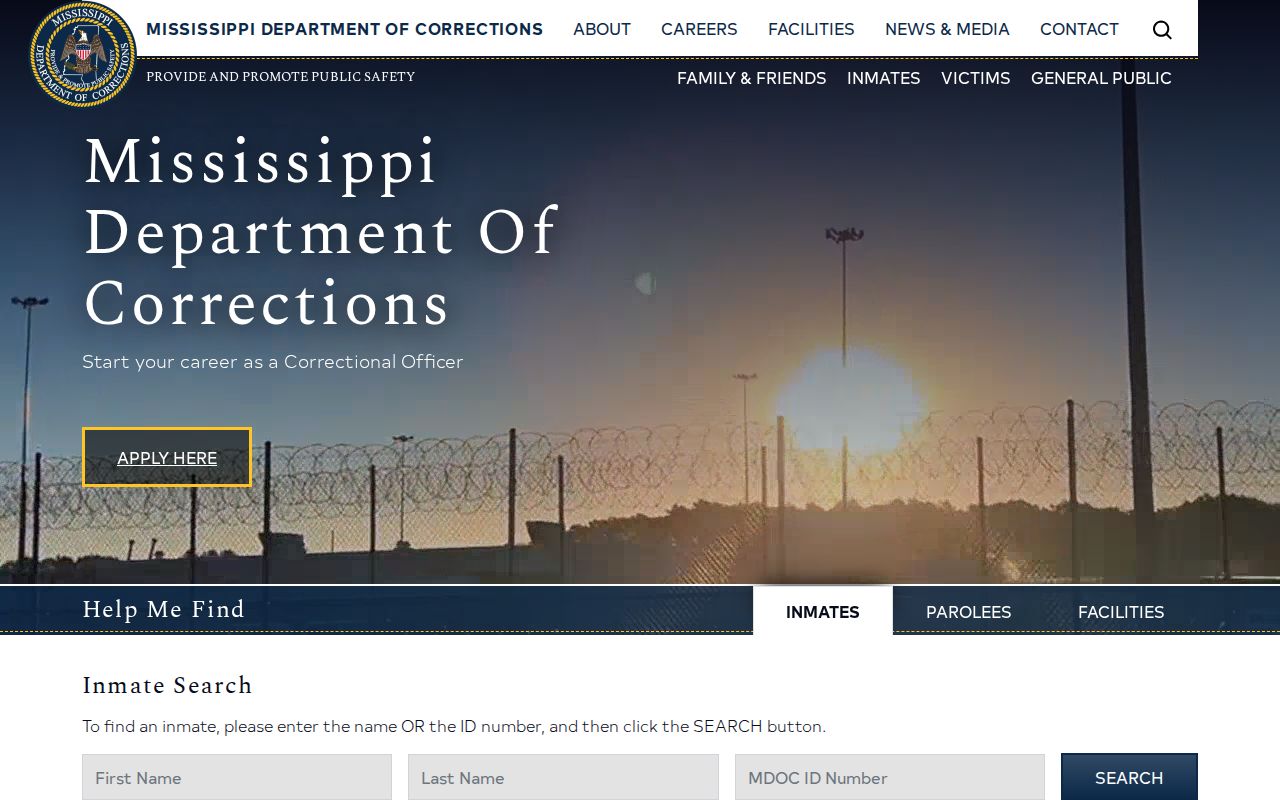
The captured page shows the official starting point for a state record, which must still be matched to the correct Copiah County person and status.
Copiah County Recent Release Records
The official Copiah County site did not publish a current roster, released-inmates view, rolling 24-hour or 72-hour list, archive window, update schedule, or sheriff mobile app when the research was completed. That finding is limited to the public channels reviewed. It does not mean the jail lacks an internal booking system.
For a time-window request, give exact start and end timestamps in Central Time and seek existing jail-docket entries or an existing electronic extract. Ask for the name, booking or commitment date, actual release time, method, authority, and receiving agency when a transfer occurred. If the system cannot query by time, ask for any daily prisoner or meal log and the related docket pages. Do not ask the sheriff to create a custom list that does not exist.
Note: A current phone answer helps with urgency, while a dated jail-docket entry supplies the durable Copiah County release record.
Copiah Supervision After Release
Mississippi divides decision and supervision roles. The Mississippi State Parole Board makes parole decisions. MDOC Community Corrections supervises parole, court-ordered probation, earned-release supervision, and other community statuses. Probation comes from a court and is not the same as release from prison. Parole is conditional release tied to an MDOC sentence.
Search MDOC first and note the exact public status and MDOC number. Then contact the Copiah Probation and Parole Office to ask which office holds the case and whether public status is active, completed, transferred, or revoked. A person can have a valid past release date and later return to custody after a violation process. Each event should be recorded separately.
215 South Extension Street
Hazlehurst, MS 39083
601-894-3806
Fax: 601-894-5729
Copiah VINE and Federal Releases
Mississippi VINELink supports a specific-person search and custody notifications. The state program covers MDOC and participating county jails, so a Copiah match or confirmation from SAVIN is needed before assuming a county feed. Read the event with its source agency. Release, transfer, temporary movement, and other changes are different events, and VINE is not a certified discharge record.
The BOP Inmate Locator is for federal sentences and many federal releases from 1982 forward. It cannot prove release from Copiah County Jail. ICE ODLS is mainly a current detention locator with limited recent-release visibility. The U.S. Marshals Service has no comparable public historical locator. A federal pickup from Copiah is a transfer until the correct federal record shows otherwise.
Copiah Release Status Sources
No single search covers every custody system. Select the source from the legal custody path, and use a durable record when the event is historical. A current-custody tool answers where someone is now. A release record answers how a past custody episode ended.
| Source | Still in custody | Released or transferred |
|---|---|---|
| Copiah sheriff | Current phone inquiry may confirm a county hold | Permanent jail docket records discharge method and authority |
| MDOC search | Shows state location or status when public | May retain release, discharge, or supervision information |
| VINE | Participating agency card may show custody | Event alert corroborates a change but is not certified proof |
| Court file | May show detention or bond orders | Shows the order or disposition authorizing the change |
| BOP locator | Federal location and status | Federal released result and date for covered records |
A zero result must be treated with care. It may reflect spelling, a different system, a transfer, restricted data, or a case that never entered state corrections. Compare at least two identifiers and record the date of each search.
Copiah Bond Release Confirmation
Copiah Justice Court draws a useful local line between legal authority and physical departure. A justice judge sets bond at a felony initial appearance, while a defendant who has not bonded out may seek a preliminary hearing. A bond amount or signed order does not prove that all conditions were met or that jail processing ended.
Pair the court entry with the sheriff's actual release record. The order explains why release was allowed. The jail docket records the duration and manner of discharge. If a person left close to midnight, the order date, bond transaction, and physical release time can fall on different calendar dates. Use the actual timestamp for a recent-release window.
Copiah Release Orders by Court
Local court routing is unusually clear. Justice Court handles misdemeanors, initial appearances, bond, and preliminary felony stages. The Circuit Clerk keeps pleas, indictments, court orders, minute references, and the complete Circuit Court proceeding record. Mississippi Electronic Courts may offer access for participating courts and cases, but access varies and the local clerk remains the source for confirmation.
Ask for the document that fits the event: a bond order, dismissal, sentence, time-served credit, revocation, discharge, or final disposition. Sealed, expunged, juvenile, and otherwise restricted matters may not be open. The court file proves legal action. It usually cannot replace the jail entry for the minute custody actually ended.
Note: Court authority and jail execution are complementary facts, so compare both when the exact Copiah County release time matters.
Copiah Release or ICE Transfer
An ICE detainer can turn an expected county release into another custody event. ICE describes a detainer as a request for advance notice and up to 48 additional hours so the agency can assume custody. Thus a person can be released from the Copiah sheriff's legal custody without returning to the community.
Request the receiving-agency entry and then check ICE ODLS when immigration custody applies. ODLS is not a permanent historical release database, and absence does not prove freedom. Keep the county discharge, ICE pickup, and any later immigration release as separate dated events.
Copiah Release Records After Expungement
Release does not erase a jail or court record. Mississippi Code section 99-19-71 addresses several expungement paths. Subsection 4 applies when a person was arrested and released, then the case was dismissed, dropped, left without disposition, or ended in acquittal. The person must obtain the proper court order. Release by itself does not remove the docket or a copied photo.
Effective July 1, 2026, HB 1546 changed the general waiting period for one qualifying felony to three years after successful completion of all sentence terms, subject to the law's remaining requirements and exclusions. After an order, each lawful custodian may need to implement it. Ask the issuing court and record holder how the order applies; do not assume all independent copies disappear.
Copiah Jail Release Operations
Copiah Jail Administrator Charles Cunningham has a current statewide operational role. A May 2026 WLBT report said he founded the Mississippi Jail Administrators Association to coordinate improvements in detention operations, including staffing and mental-health concerns.
This fact supplies facility context, not evidence of a Copiah County release schedule, online roster, or request policy. No release hour, weekend practice, or public update cadence was verified. Readers should rely on the sheriff's official contact and the actual docket entry rather than infer a practice from broader operational news.
Note: Operational news about jail administration does not establish a public release policy, feed cadence, or record-retention rule.
Copiah County Release Facility
The Copiah County Jail is the sole verified adult detention facility in the county map. It is the county pretrial and short-sentence jail at the sheriff's Gallman complex. The official map did not identify a separate state prison, federal prison, ICE center, work-release center, or long-term municipal jail within Copiah County.
Community release may follow bond, court action, time served, or local sentence completion. A transfer to MDOC, another jail, USMS, or ICE requires a different search path. The sound sequence is arrest and booking, county custody, release or transfer, then any supervision. Preserve each step as its own fact.
Note: Copiah County has one verified adult jail, but a local arrest can still lead to custody outside the county.